
Discover how HubSpot's new Contracts object revolutionizes revenue management, streamlining post-sales processes and enhancing data accuracy across teams.

Have you ever felt the frustration of contract and revenue data being scattered across countless systems and spreadsheets? You know the drill. The deal closes — and suddenly the real work begins. Spreadsheets are updated manually. Renewal dates live in one place, MRR in another, contract terms in a third. Customer Success can't see what Sales actually agreed to. Finance is reconciling numbers that should already match. RevOps is patching together reports from three different exports.
Many of us have spent years dealing with this through manual workarounds and band-aid solutions.
But there's good news from HubSpot. They've quietly introduced a new Contracts object in private beta — and it looks set to transform how we handle the entire revenue lifecycle after a deal is won.
What it actually does
Three things stand out:
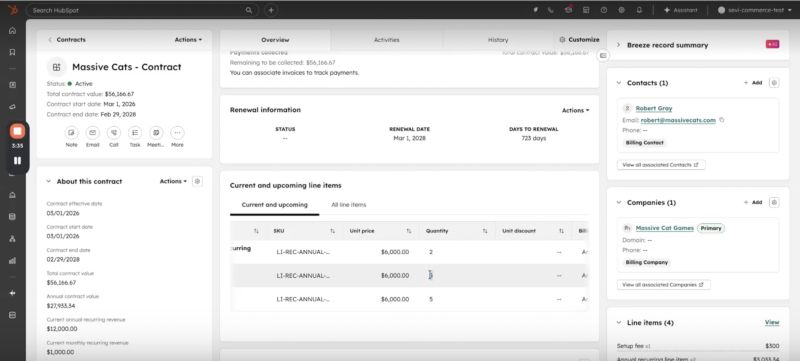
1. Automatic contracts based on accepted quotes. No more manual data entry once a deal is closed. The contract is generated directly from the quote the customer signed off on — line items, pricing, and terms carry through automatically.
2. Mid-contract change management built in. Upgrades, downgrades, price adjustments, expansions — all handled directly in HubSpot, in an object purpose-built for these post-sales motions. No more parallel spreadsheets tracking which customer is on which version of which agreement.
3. Native calculations for the metrics that matter. TCV, ACV, MRR, and ARR are calculated automatically. Until now, CPQ tools have largely stopped right after the quote was accepted. We finally have an object that follows the contract all the way through its lifetime.
Why this matters for Revenue Architecture
For those of us working with the Winning by Design bowtie data model, this is a meaningful shift. Until now, HubSpot has had strong tooling for the left side of the bowtie — acquisition. But the right side — onboarding, retention, expansion — has been underserved at the data-object level. We've made it work with custom objects, deal pipelines bent into renewal flows, and creative property design. It works, but it's a workaround.
The Contracts object means we finally have a native object purpose-built for right-side processes. That's a structural change, not just a feature update.
What becomes possible
This is what enables a genuine Lean Revenue Factory — where data drives decisions and automated processes run end-to-end through the entire customer journey, not just up to closed-won.
Concretely, that means:
- Renewal motions triggered by actual contract end dates, not manually maintained spreadsheet columns
- Expansion plays that fire when contract terms or usage thresholds are reached
- Forecasting that ties net new ARR, expansion ARR, and churn ARR back to specific contracts
- Customer Success dashboards that reflect real entitlements rather than approximations
- Finance and RevOps working from the same source of truth, not three reconciled exports
The downstream effect: fewer errors, dramatically less administrative overhead, and actionable insights that until now lived in spreadsheet exports refreshed every Monday morning.
A practical note
It's still in private beta, so this isn't a full production rollout yet. Existing customers with significant historical contract data will need a thoughtful migration plan. And as always, the object is only as useful as the upstream data — quotes, deals, line items — that feeds it. Clean inputs, clean outputs.
But the direction of travel is unmistakable. HubSpot is closing the post-sales gap, and the Contracts object is one of the most important steps in that direction.
Closing thought
If you're running a HubSpot portal where renewals, expansions, and contract changes are still managed in spreadsheets, this is worth getting on your 2026 roadmap. And if you're already on the private beta — I'd genuinely love to hear how it's working for you.