
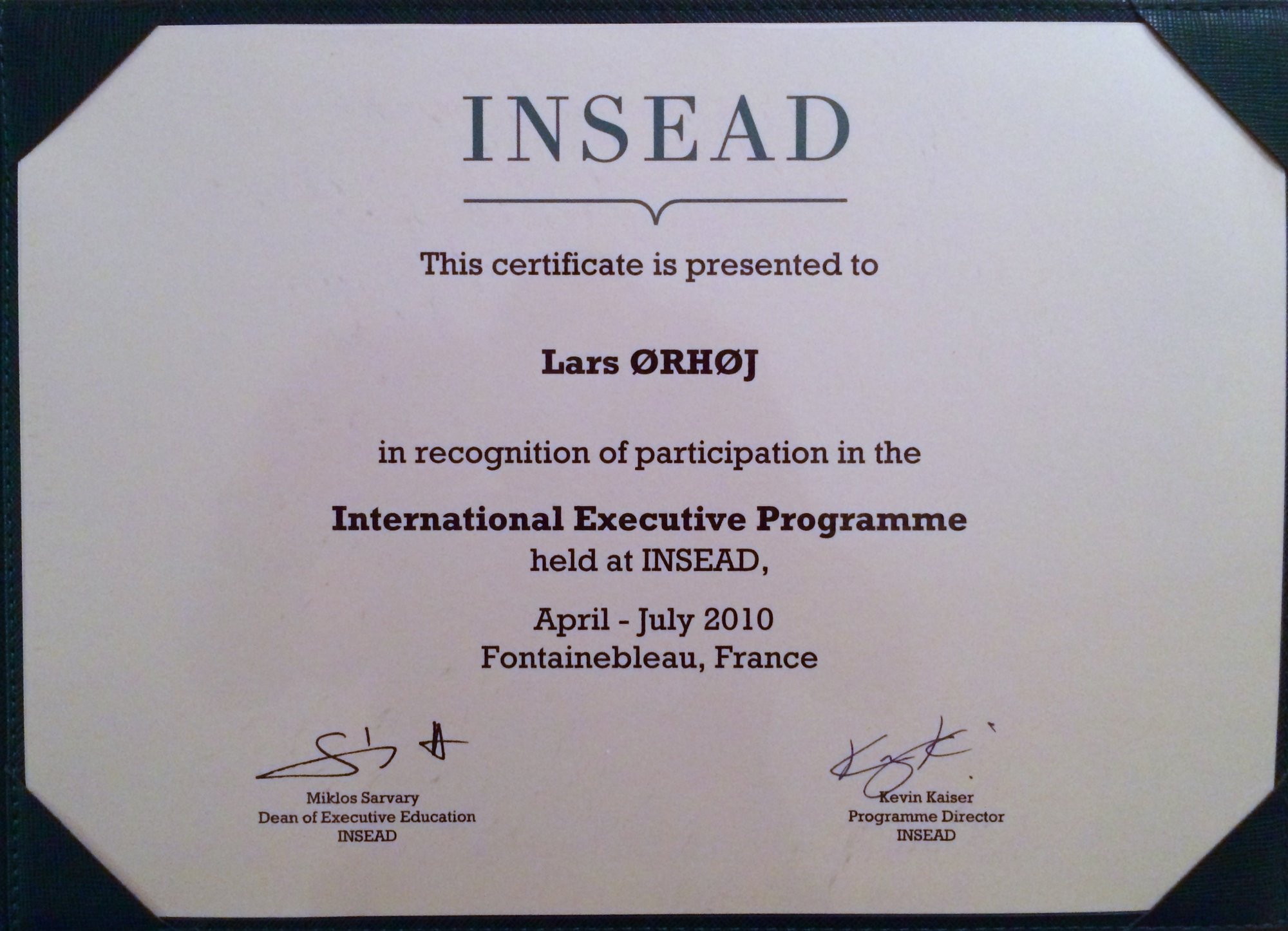
A general management diploma from INSEAD — one of the world's leading graduate business schools — designed to equip senior functional leaders with the breadth of perspective required to operate at general management and C-suite level.
A general management diploma, not a single discipline
The INSEAD International Executive Programme (IEP) is part of INSEAD's general management portfolio and grants INSEAD alumni status on completion. It is designed for experienced functional leaders moving toward broader responsibility — those who need to think and decide across the whole business, not just within their own discipline.
The curriculum spans the full set of executive disciplines, taught by INSEAD faculty through a combination of lectures, case method, simulations, and group work. The diploma signals not depth in one function, but the breadth and analytical fluency to lead across functions in a complex, internationally exposed business.
Applied in practice
Why the breadth matters in revenue architecture
Revenue architecture work doesn't sit inside a single function. It spans marketing, sales, customer success, finance, and operations — and it lives or dies on whether those functions can be reasoned about as one system. The IEP curriculum was built around exactly that integration.
In Nordic B2B advisory engagements — particularly the cross-border work between Denmark, Germany, and the wider European market — the modules on Culture and Business Systems and International Political and Economic Analysis show up constantly. Erin Meyer's Culture Map didn't replace that grounding; it built on it.
The financial modules matter for a different reason: a credible conversation with a CFO or CRO about CAC payback, LTV, or unit economics requires more than RevOps vocabulary. It requires fluency in how the rest of the business actually accounts for investment and return.
And the soft-discipline modules — Leadership, Organizational Behavior, Negotiation — are what allow strategic recommendations to actually land inside a client organisation. Strategy that ignores how organisations make decisions is just well-formatted opinion.
The diploma certifies one thing above all: the ability to reason across the whole firm, not just within a function — which is the table stake for any advisor working at C-suite level.
Curriculum
Eleven disciplines, one integrated view of the firm.
The IEP curriculum covers the core management disciplines that every general manager is expected to command. Each module is taught not in isolation but in relation to the others — the point of an executive programme is precisely to see how the pieces fit.
01 - Marketing
The strategic discipline of understanding markets, segments, and customer behaviour — from positioning and brand strategy to go-to-market execution. Builds the analytical foundation for how organisations create and capture value through customer relationships.
02 - Organizational Behavior
How people actually work — individually, in teams, and inside organisational structures. Covers motivation, group dynamics, organisational design, and the cultural and political forces that determine whether strategy gets executed or quietly stalls.
03 - Finance and Management Accounting
The language of business at the executive level: reading financial statements, understanding cost structures, interpreting margin and contribution, and using management accounting to drive decisions rather than merely report on them.
04 - Technology and Operations Management
The integration of technology, processes, and supply chain into a coherent operational model. Equips leaders to evaluate the strategic role of operations in competitiveness — from process design to digital transformation.
05 - Leadership
The development of executive-level leadership capability: vision-setting, leading through change, developing other leaders, and the self-awareness required to lead at scale. Combines theory with personal feedback and reflection.
06 - Negotiation and Decision Making
Frameworks for high-stakes negotiation — BATNA, integrative bargaining, multi-party negotiation — and structured decision-making under uncertainty. Practical theory tested through simulation and the case method.
07 - Financial Management
Corporate finance for executives: capital structure, investment appraisal, valuation, and the financial implications of strategic choices. The discipline of allocating capital toward growth and sustainable return.
08 - Strategy
Competitive strategy and strategic positioning — from industry analysis and value-chain thinking to dynamic strategy, capability development, and platform competition. The art of choosing where, and how, to compete.
09 - International Political and Economic Analysis
Understanding the macro environment in which global business operates: geopolitics, trade regimes, monetary policy, and emerging-market dynamics. Essential context for any leader operating beyond a single national market.
10 - Culture and Business Systems
Navigating cultural variance across markets — leadership styles, decision-making norms, communication patterns. Builds the cross-cultural fluency required to lead and partner across national business systems.
11 - Corporate Social Responsibility
Stakeholder capitalism, sustainability, ethics, and the long-term obligations of the firm beyond shareholder return. The framework executives use to position the company within society, not just within the market.
Timeline
2010
Obtained the INSEAD Diploma
Next step
Thirty minutes to see if we're a fit.
Bring the messy version. We'll sketch what a good engagement looks like, or not — either way you leave with something useful.